Stop Teaching Solar. Start Teaching Confidence.
Why the highest-performing solar businesses aren't winning because they have better products—they're winning because they understand how homeowners actually make decisions.
The solar industry has become obsessed with optimisation.
Optimising ad spend.
Optimising lead response times.
Optimising proposal software.
Optimising follow-up sequences.
Optimising appointment conversion rates.
Yet despite all of these improvements, one problem refuses to disappear.
The homeowner receives a professionally designed proposal…
…and then disappears.
For years, we've blamed the usual suspects.
"They're shopping around."
"They're waiting for another quote."
"They've gone quiet."
"They've gone with the cheaper installer."
Sometimes that's true.
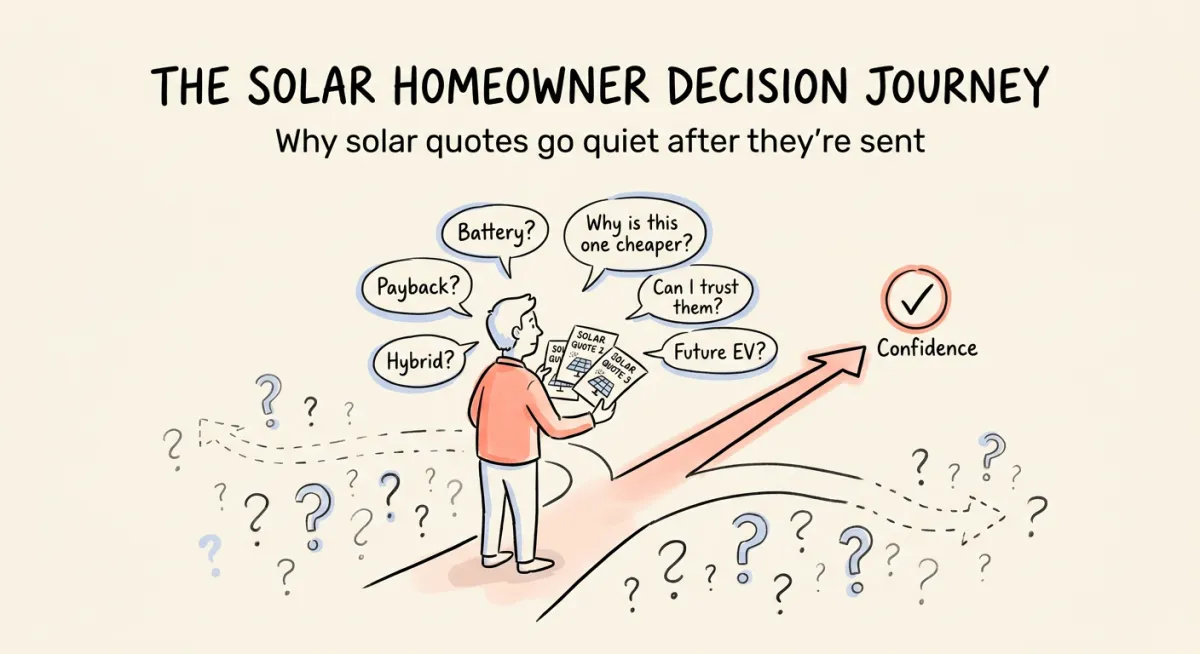
But after studying hundreds of homeowner conversations, we think the industry has been solving the wrong problem altogether.
The homeowner isn't comparing quotes.
They're comparing confidence.
And that's a completely different sales process.
The uncomfortable truth about solar sales
Let's ask an uncomfortable question.
How many times has your team sent a follow-up that looked something like this?
"Hi John, just checking whether you've had a chance to review your proposal?"
Or perhaps…
"Just seeing if you had any questions before we touch base later this week."
There's nothing inherently wrong with those messages.
But there's a deeper issue.
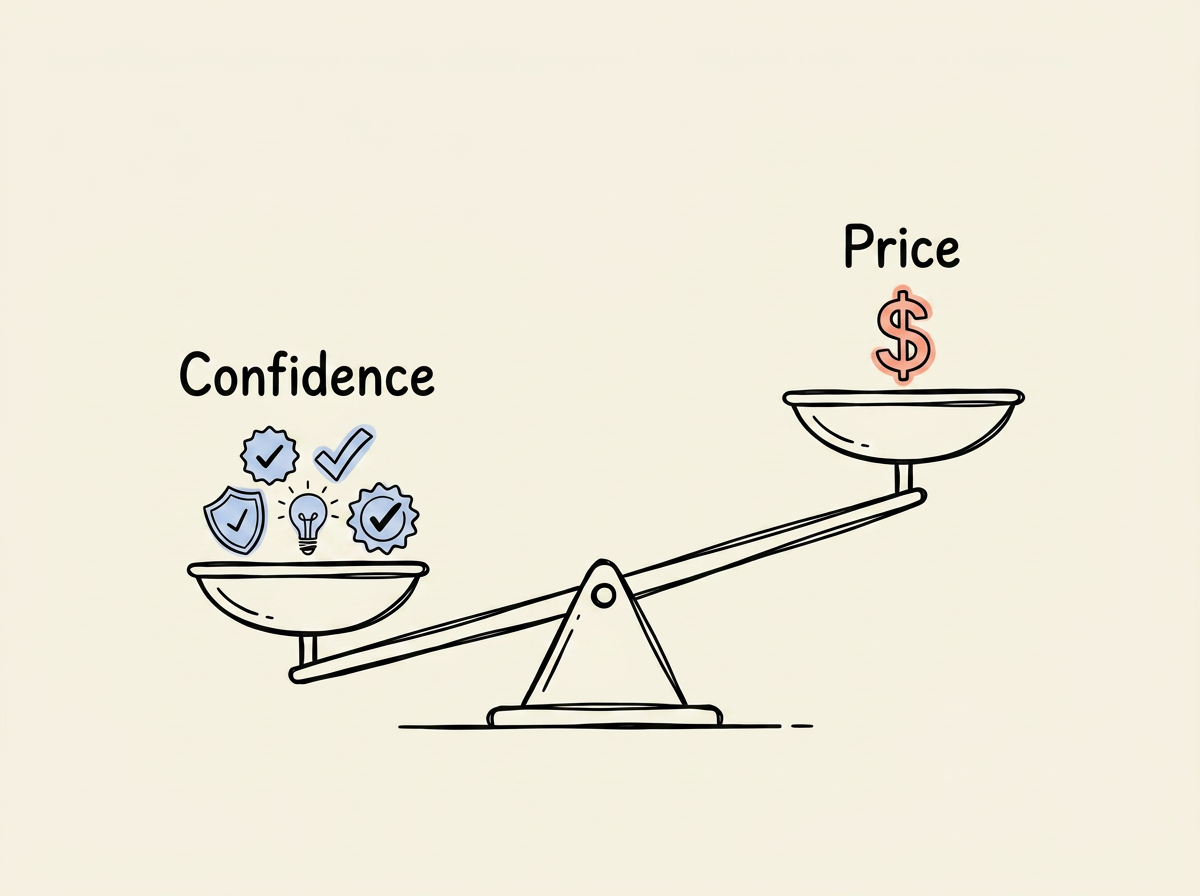
You're asking someone to make a decision before you've helped them become confident enough to make one.
Think about the last major purchase you made.
Was your hesitation really about price?
Or was it about making the wrong decision?
Solar is no different.
Homeowners don't buy solar.
They buy certainty.
This is the first mental model we believe every solar business needs to adopt.
Your customers are not buying:
440W panels
Hybrid inverters
13.5kWh batteries
Consumption monitoring
Blackout backup
They're buying confidence that those products are right for their home.
That's a subtle distinction.
But it changes everything.
Because once you understand that, you stop asking:
"How do we close more sales?"
And start asking:
"What uncertainty is preventing this homeowner from moving forward?"
Those are two very different businesses.
The real customer journey isn't your sales pipeline
Most CRMs track the customer journey like this:
Lead ➡️ Appointment ➡️ Quote ➡️ Follow-up ➡️ Sale
That's your internal process.
It isn't the customer's.
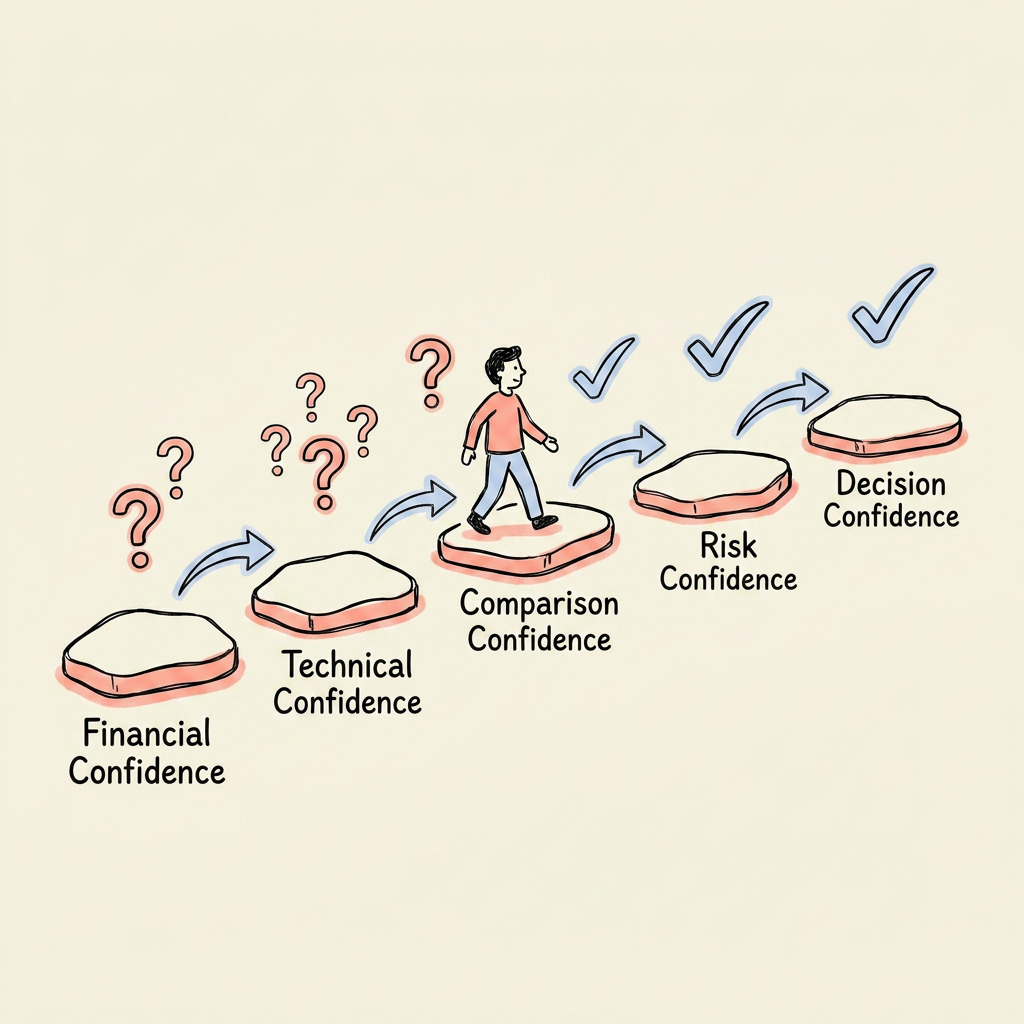
The homeowner's journey looks more like this:
Financial Confidence
"Will this actually save me money?"
↓
Technical Confidence
"Do I understand what I'm buying?"
↓
Comparison Confidence
"Why are these quotes so different?"
↓
Risk Confidence
"What haven't I thought about yet?"
↓
Decision Confidence
"Am I comfortable signing today?"
The mistake most solar businesses make is assuming a homeowner reaches "Decision Confidence" the moment they receive a proposal.
In reality, many haven't even reached Technical Confidence.
The biggest opportunity in solar isn't better follow-up.
It's better education.
Here's a question worth asking.
Why do homeowners spend weeks researching after they've already received your proposal?
Because they're not researching products.
They're researching confidence.
They're typing questions into Google that they were never comfortable asking the installer.
Questions like:
"Why is one solar quote $5,000 cheaper?"
"Should I replace my inverter?"
"Can I add a battery later?"
"Is this monitoring app actually any good?"
"Will I regret buying a smaller battery?"
Every one of those searches represents uncertainty that wasn't resolved during the sales process.
Now imagine your business answered those questions before the customer even thought to ask them.
That's where the real competitive advantage begins.
AI isn't replacing your sales team.
It's filling the confidence gap.
This is where we think most conversations about AI completely miss the point.
The industry talks about:
Faster response times
AI voice agents
Automated follow-up
Appointment booking
Useful?
Absolutely.
Transformational?
Not really.
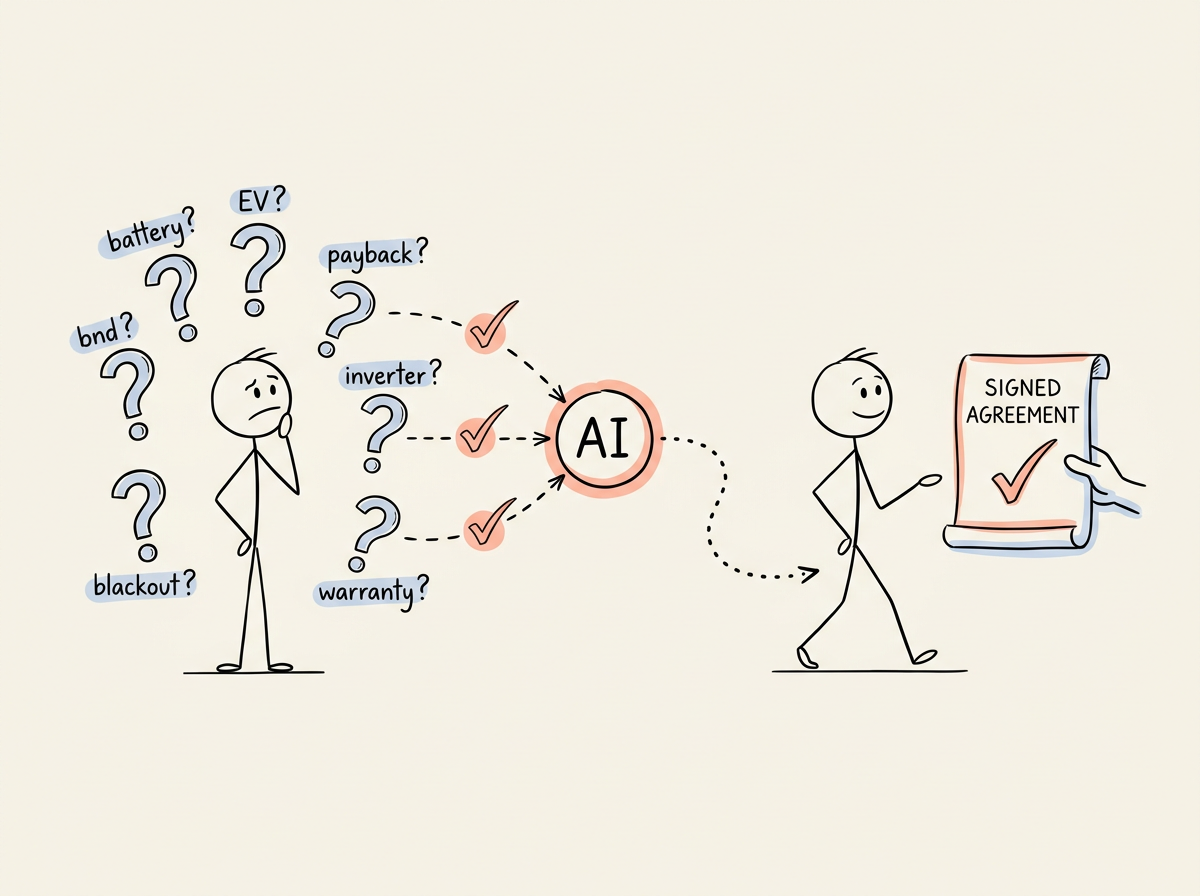
The real opportunity is creating an AI that understands the homeowner's entire decision journey.
Imagine a homeowner uploads a photo of their inverter.
Instead of sending another follow-up reminder, the AI says:
"I can see you've got a Sungrow SG10RT. If you're considering batteries in the future, there are a few different pathways depending on whether you keep your existing inverter or retrofit a hybrid system. Would you like me to explain the trade-offs?"
That's not automation.
That's expertise.
Now imagine another homeowner.
Young family.
High electricity bills.
Planning to buy an EV next year.
They receive an entirely different conversation.
Not because your team manually wrote it.
Because the AI understands their situation.
The follow-up doesn't change because the calendar says it's Day 7.
It changes because the homeowner's uncertainty has changed.
This is why generic nurture sequences are dying
For years we've built nurture campaigns around time.
Day 1.
Day 3.
Day 7.
Day 14.
But homeowners don't make decisions according to a calendar.
They make decisions when enough uncertainty has been removed.
That means the future of solar sales won't be measured by how many follow-up emails you send.
It will be measured by how effectively every interaction increases confidence.
Every conversation should answer one question the homeowner doesn't yet know they need to ask.
Not because it's clever marketing.
Because that's how trust is built.
The businesses that win won't have the best AI.
They'll have the smartest conversations.
Every solar company will eventually have AI.
Every installer will automate follow-up.
Every proposal platform will integrate conversational assistants.
Technology alone won't be the differentiator.
Understanding the customer will.
The businesses that outperform the market over the next decade won't simply educate homeowners about solar.
They'll educate them about making the right decision.
They'll understand that every homeowner is somewhere on a decision journey.
Some need help understanding payback.
Some need help comparing batteries.
Some need reassurance that spending more today saves regret tomorrow.
Others simply need someone to explain the trade-offs in plain English.
That's where AI becomes genuinely valuable.
Not because it replaces your salespeople.
Because it allows every homeowner to experience the knowledge, patience and expertise of your very best consultant—every hour of every day.
Frequently asked questions
Why do solar quotes go quiet after they're sent? Usually not because the homeowner chose a competitor or found something cheaper. A quote creates new questions — about battery sizing, inverter compatibility, payback and future upgrades — that most installers never answer. The homeowner goes quiet because they've stalled on one of those questions, not because they've decided against you.
What is the Homeowner Decision Journey? It's the five stages of confidence a homeowner clears before signing a solar contract: Financial, Technical, Comparison, Risk and Decision Confidence. Receiving a proposal only moves them one step. Most stall well before Decision Confidence — which is where quoted deals quietly die.
Is faster follow-up enough to win solar deals? Speed wins the first conversation, but it doesn't help a homeowner who's stuck on a decision. Once a quote is out, chasing faster or harder just applies pressure. What moves the deal is removing the specific uncertainty keeping them from committing.
How can AI help convert solar quotes without being pushy? By reading where each homeowner is in their decision journey and answering the next unanswered question — battery compatibility, EV planning, why two quotes differ — instead of sending another reminder. Used this way, AI extends your best consultant's expertise to every lead, building confidence rather than chasing a signature.
The next evolution of solar sales
For years, the industry has focused on generating more leads.
Then we focused on converting more leads.
The next frontier isn't either of those.
It's helping homeowners make better decisions.
Because homeowners don't remember who followed up the fastest.
They remember who helped them feel confident enough to invest tens of thousands of dollars in their home.
And that's why we believe the future belongs to businesses that stop thinking of AI as a follow-up tool...
...and start building AI that understands the homeowner's entire decision journey.
See where your customers lose confidence.
Most solar businesses have never mapped where in the decision their quotes actually stall. We'll walk through your last stalled deals against the Solar Homeowner Decision Journey and show you which confidence stage is costing you the sale - before you spend another dollar on faster follow-up.
Book a Free 30-Minute Discovery Call →


