
Cost per booked appointment - the solar metric that beats cost per lead in Australia
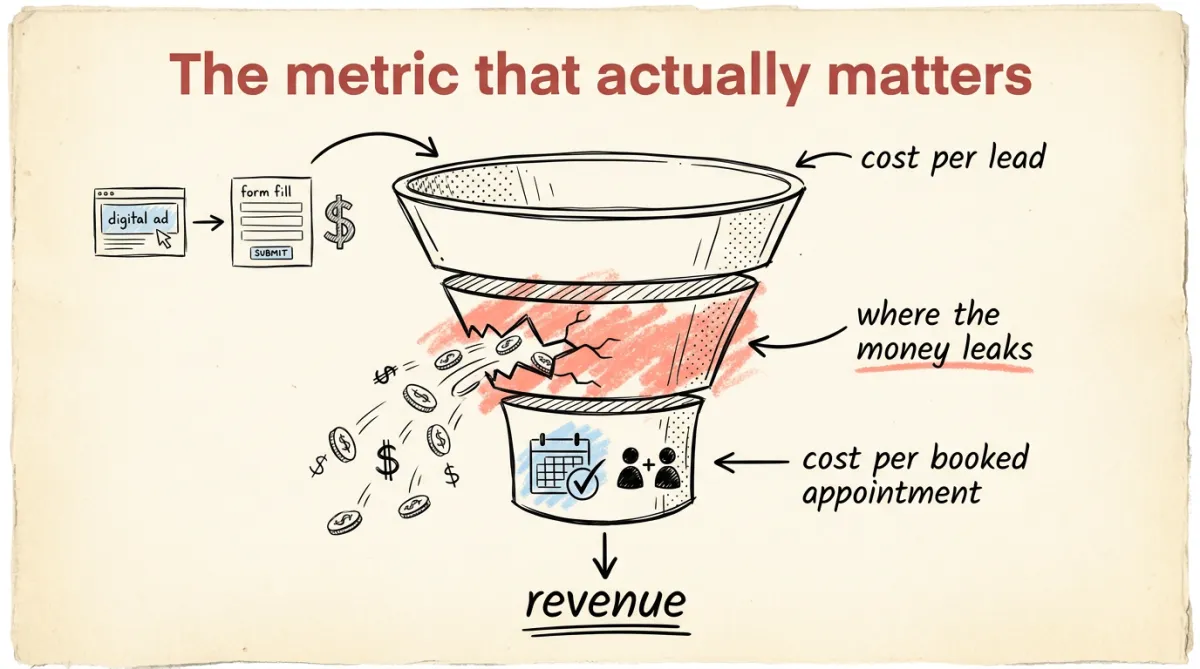
Most solar businesses in Australia track cost per lead. It is a reasonable thing to measure - but it is the wrong number to optimise. Cost per lead tells you what you paid for attention. Cost per booked appointment tells you what you paid to get a homeowner in the room. Only the second number maps to revenue.
Why is cost per lead the wrong metric for solar businesses?
Cost per lead feels like the right measure because it is the most visible one. You spend money on Facebook or Google ads, leads come in, you divide the spend by the number of enquiries and get a tidy number. When it rises, you push back on the agency. When it falls, you feel like something is working.
The problem is what CPL does not measure: whether anything happens after the form is filled.
A lead is not a sale. It is not an appointment. It is not even a conversation. It is a signal of interest - warm when it arrives, cooling fast. The gap between "form filled" and "homeowner in your sales team's calendar" is where most solar marketing budgets actually leak. CPL measures the front of that gap precisely and the back of it not at all.
Solar businesses that optimise for CPL end up chasing cheap leads that do not convert, instead of investing in the conversion step that turns any lead - of any acquisition cost - into a confirmed assessment.
What is cost per booked appointment in solar, and how do you calculate it?
Cost per booked appointment is the total you spend to get one confirmed residential assessment in the calendar - including advertising, lead acquisition, and the cost of the follow-up required to book it.
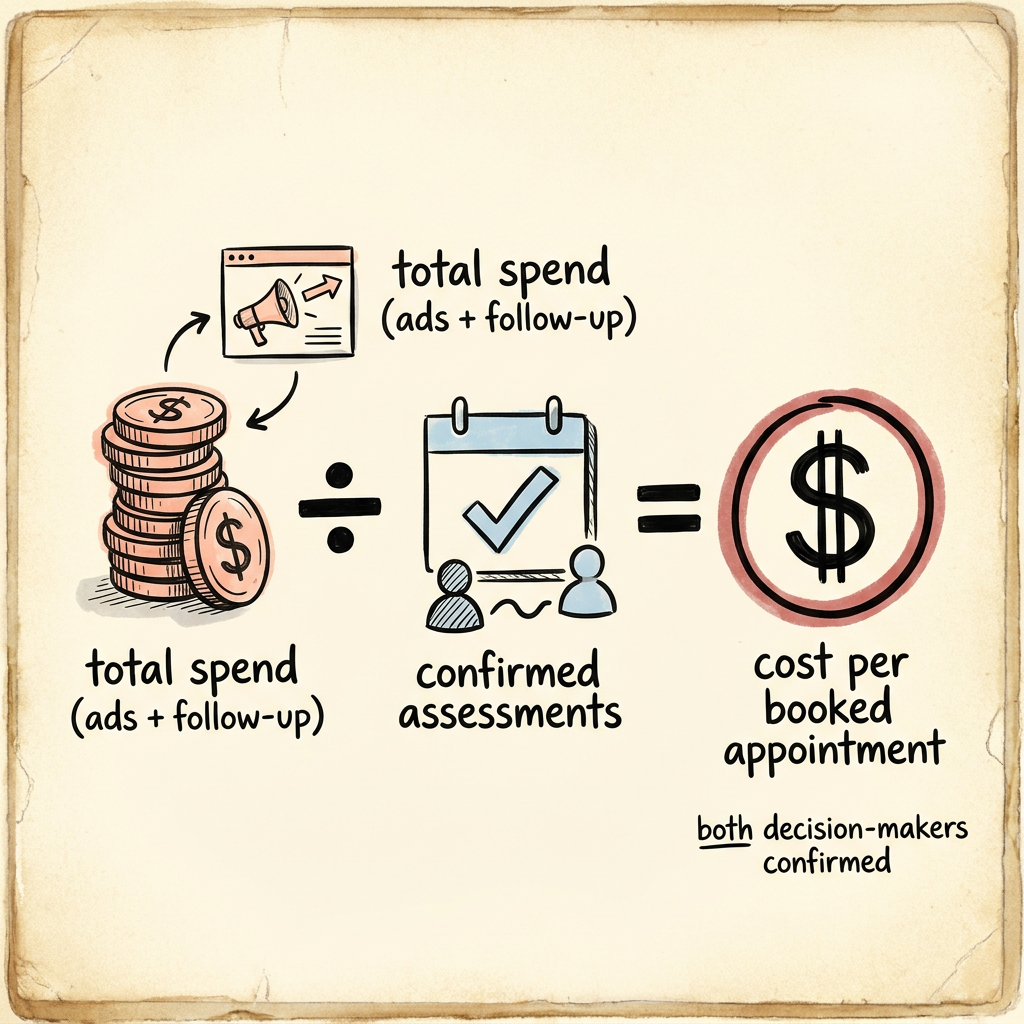
The calculation is straightforward:
Total marketing and follow-up spend ÷ confirmed booked assessments = cost per booked appointment
The word "confirmed" matters here. A booked slot where only one partner is home and the other has not agreed to anything is not a confirmed appointment - it is a set-up for a wasted trip and a stalled deal. A confirmed assessment means both decision-makers are attending, the time is locked, and someone has spoken to the lead. That is the commercial event worth tracking and optimising.
For a residential solar sale in Australia - typically a 6.6kW system in the $5,000-$6,000 range after rebates (Solar Choice Price Index, July 2026) - the confirmed assessment is where revenue starts. Optimise for that, not for the step before it.
Why does follow-up cost belong in your cost-per-appointment calculation?
Most solar businesses calculate CPL correctly and cost per booked appointment incorrectly - because they leave follow-up out of the calculation entirely.
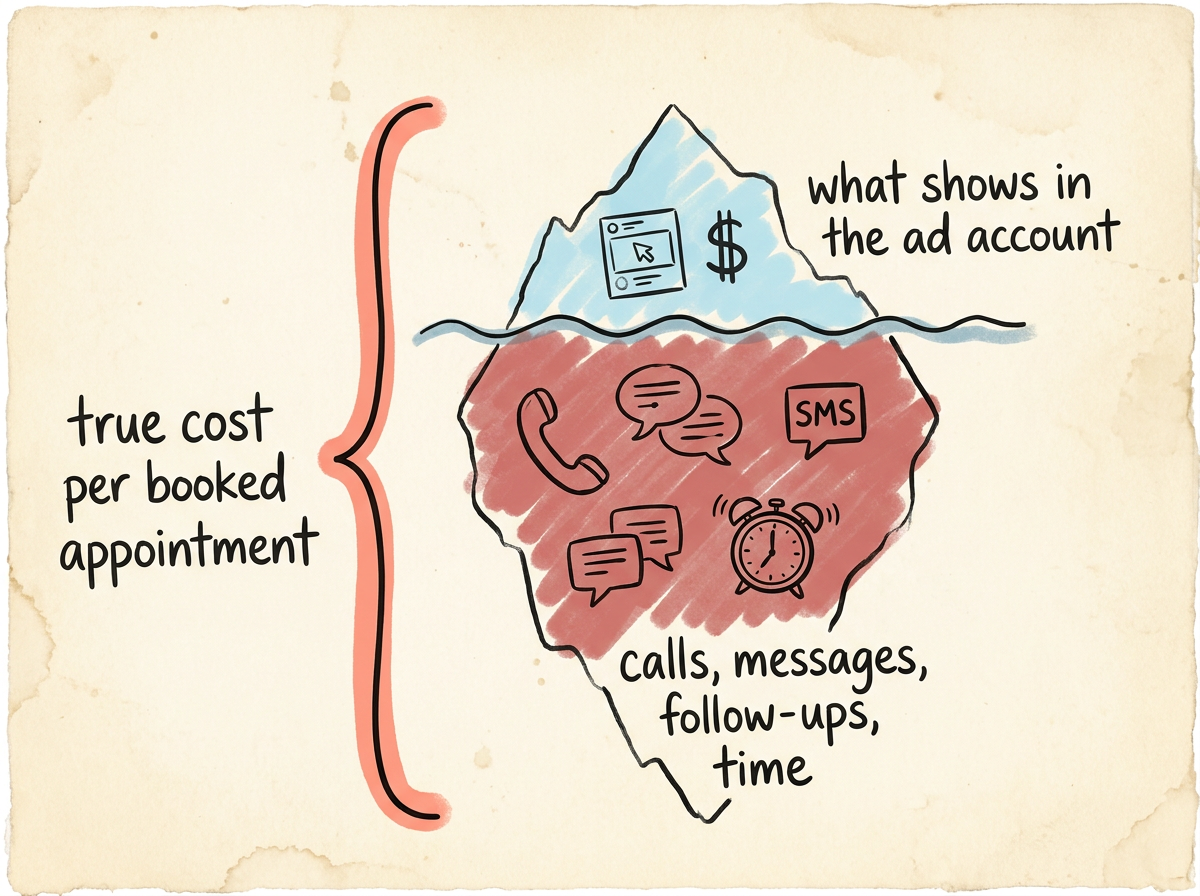
Think about what it actually takes to book a confirmed assessment. A lead arrives. Someone calls. The lead does not answer. Someone calls again. A message is left. A few days pass. An SMS goes out. By the time both decision-makers have confirmed and the appointment is locked, a meaningful amount of labour has gone into it - time that has a real cost, even if it never shows up in the ad account.
When follow-up is counted as part of the investment, the true cost per booked appointment is always higher than CPL alone suggests. The gap between the two is the invisible leak. And it is exactly the gap that a well-built, always-on follow-up engine closes - not by reducing the cost of each lead, but by increasing the proportion of leads that actually convert to confirmed assessments, so the cost per booking falls even as the spend holds steady.
What does a good cost per booked appointment look like for Australian solar?
There is no universal benchmark - and any vendor who offers one without knowing your ticket size, close rate, and follow-up process is guessing. What matters is knowing your own number and having a direction to move it.
The useful question is: what can you afford per confirmed assessment, given the value of a closed sale? In Australian residential solar, a typical 6.6kW system sits around $5,000-$6,000 after rebates. If your cost per booked appointment is already consuming a meaningful share of that margin before a closer is even in the room, the maths does not hold - and no ad optimisation will fix it, because the problem is in the conversion step, not the acquisition step.
A practical internal target: know your current number, then set a direction. Lower it while holding or growing the volume of confirmed assessments. If the only route to a lower CPL is to book more appointments than your team can run well, that is a capacity problem, not a marketing win.
Cost per lead vs cost per booked appointment - what each tells you
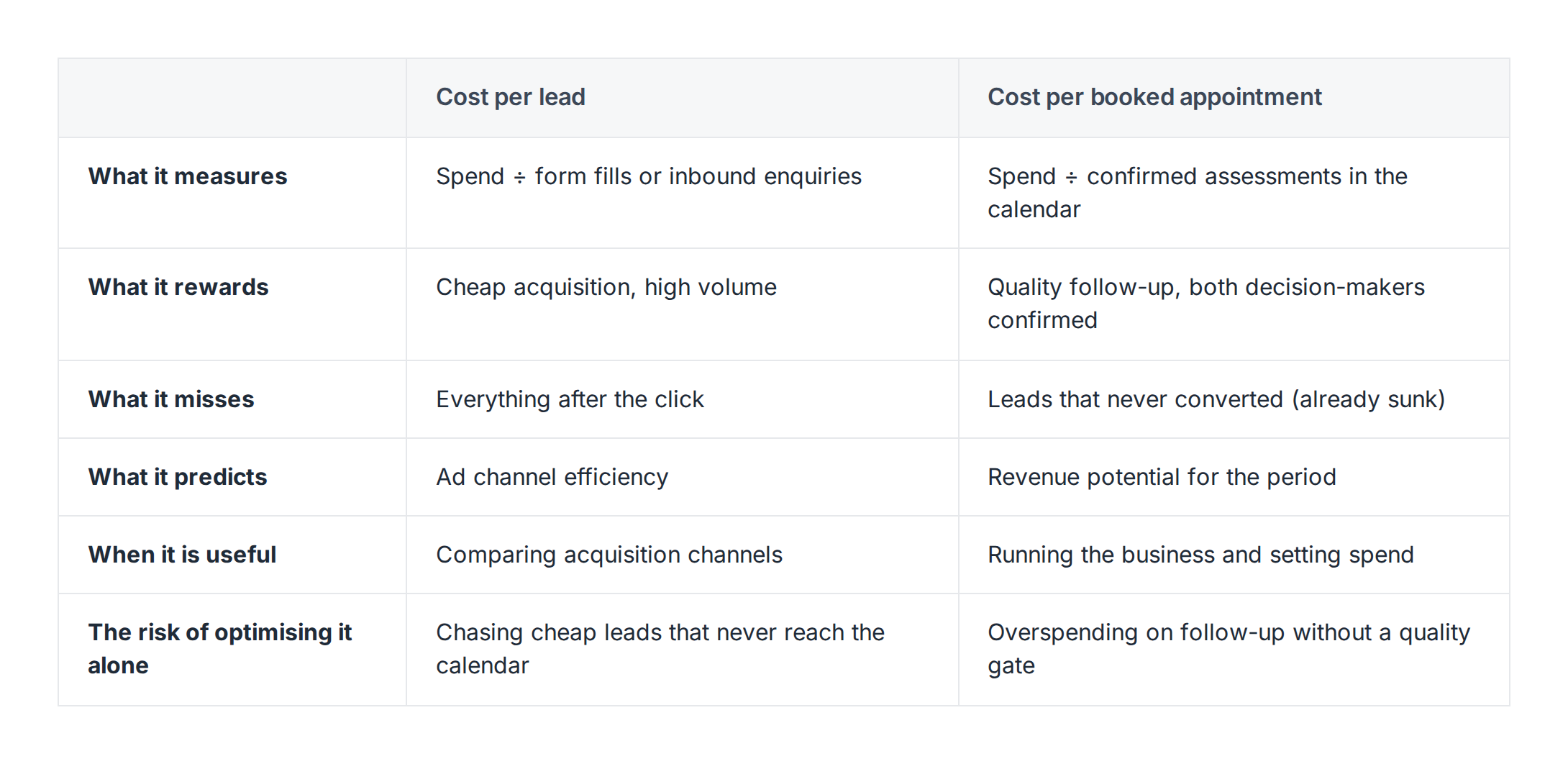
The two numbers are not in competition - they do different jobs. CPL is useful for comparing channels. Cost per booked appointment is the number that runs the business.
How does a follow-up engine shift the cost-per-appointment maths?
The biggest lever on cost per booked appointment is not ad spend - it is the conversion rate between a lead arriving and a confirmed assessment going in the calendar. More leads converting from the same acquisition spend means the same budget produces more revenue. That is where a well-built, always-on follow-up engine earns its place.
When a lead arrives and no one reaches them within the first few minutes, the odds of getting them on the phone fall significantly - research on lead response times is consistent on this. By the time someone in the team gets to that lead, the homeowner has moved on, fielded calls from competitors, or simply cooled off. The spend that acquired the lead is sunk, and cost per booked appointment rises without any new spend going out the door.
A multi-channel follow-up engine - voice, SMS, and email working together across the lead's lifecycle, not a single call and a hope - closes that gap. Every lead gets a fast, consistent first response. The follow-up continues appropriately across the lead's journey. And when a lead is ready to book, both decision-makers are confirmed before the appointment goes in the calendar.
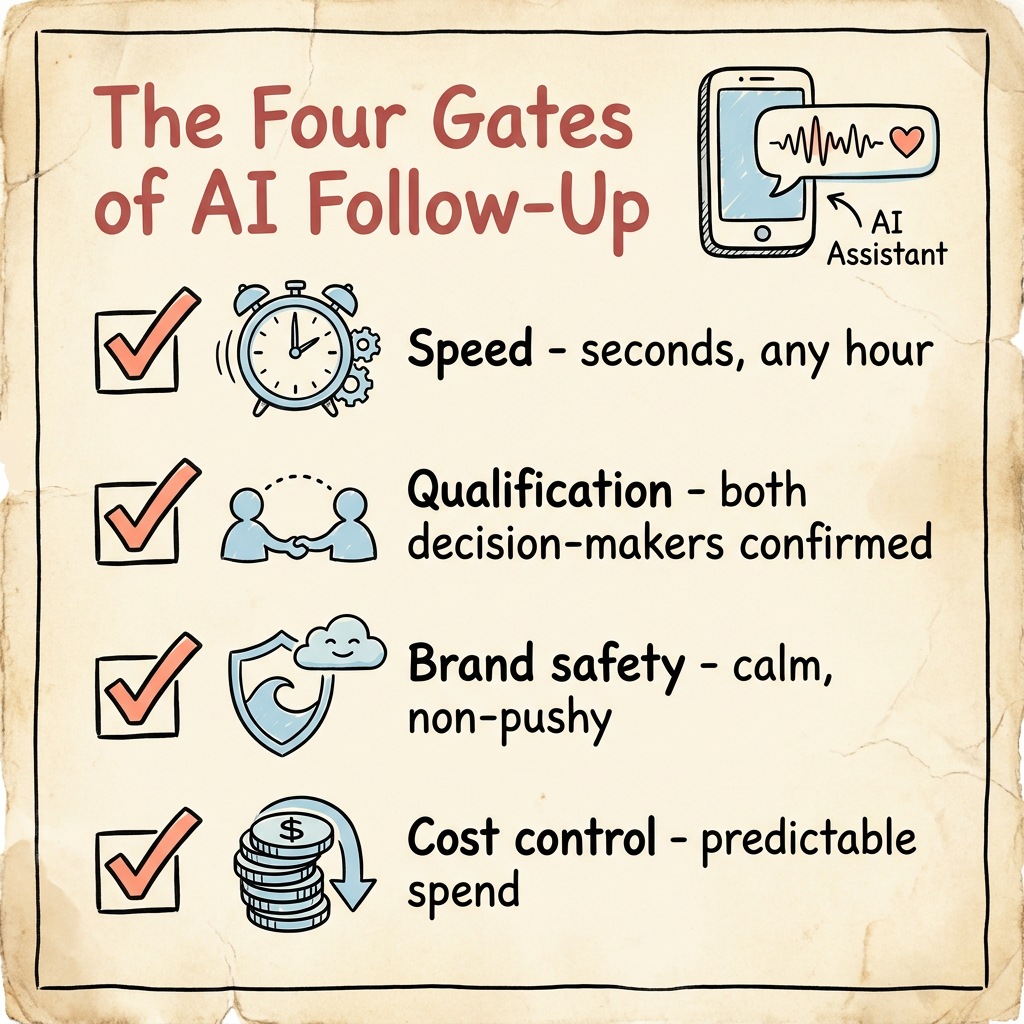
Before trusting any system with your leads, it is worth checking it against the Four Gates of AI Follow-Up - the four things any AI-driven follow-up must get right, in order, to actually lower cost per booked appointment rather than create new problems:
Speed - responding in seconds, at any hour, because the window to reach a warm lead is narrow and closes fast.
Qualification - confirming both decision-makers are attending before the appointment is booked, not after. A solo-partner booking is a half-wasted trip.
Brand safety - calm, non-pushy, compliant - because in solar, trust is the whole sale, and a blunt dialler that earns one-star reviews raises your cost per good appointment while damaging the brand.
Cost control - predictable, capped spend with no surprise phone bills at the end of the month.
A system that clears only gate one is a dialler. A system that clears all four is a follow-up engine - and the difference shows up directly in your cost per booked appointment over time.
Frequently asked questions
What is the difference between cost per lead and cost per booked appointment for solar businesses? Cost per lead measures what you paid for a form fill or inbound enquiry. Cost per booked appointment measures what you paid to get a qualified homeowner into a confirmed assessment - with both decision-makers attending. For solar businesses in Australia, only the second number maps to revenue. Cost per lead only measures the step before the real commercial work begins.
How do I calculate cost per booked appointment for my solar business? Add your total marketing spend, lead acquisition costs, and the cost of your follow-up process (staff time or tool cost) for a period, then divide by the number of confirmed residential assessments in the calendar over the same period. Count only assessments where both decision-makers are confirmed - a single-partner booking is not a conversion and should not be counted as one.
Why does follow-up cost belong in the cost-per-appointment calculation? Because follow-up is part of what you spend to produce a booked assessment. If your team invests significant time calling, leaving messages, and chasing confirmations before a booking is locked, that labour has a real cost. Leaving it out makes marketing look more efficient than it is - and hides the real lever, which is improving conversion rates between enquiry and confirmed appointment.
How does follow-up speed affect cost per booked appointment? Directly. A lead that goes unanswered for hours is far less likely to convert to a confirmed assessment than one reached within minutes. Every lead that cools before booking raises cost per appointment by adding acquisition spend without a corresponding outcome. Faster, more consistent follow-up converts more of your existing lead spend into booked assessments - which is the fastest way to lower cost per appointment without spending more on acquisition.
Is cost per lead still useful to track? Yes - but for a different job. Cost per lead is useful for comparing acquisition channels and campaign efficiency. It tells you which channel delivers enquiries most cheaply. Cost per booked appointment tells you which spend actually produces revenue. Track both; optimise on the second.
Work out your own number this week - total spend, including follow-up, divided by confirmed assessments. If it is consuming more of your margin than it should, the lever is the conversion step, not the ad account. That is the conversation a discovery call is for.


