
What Is an AI Operating System? The Business Guide for 2026
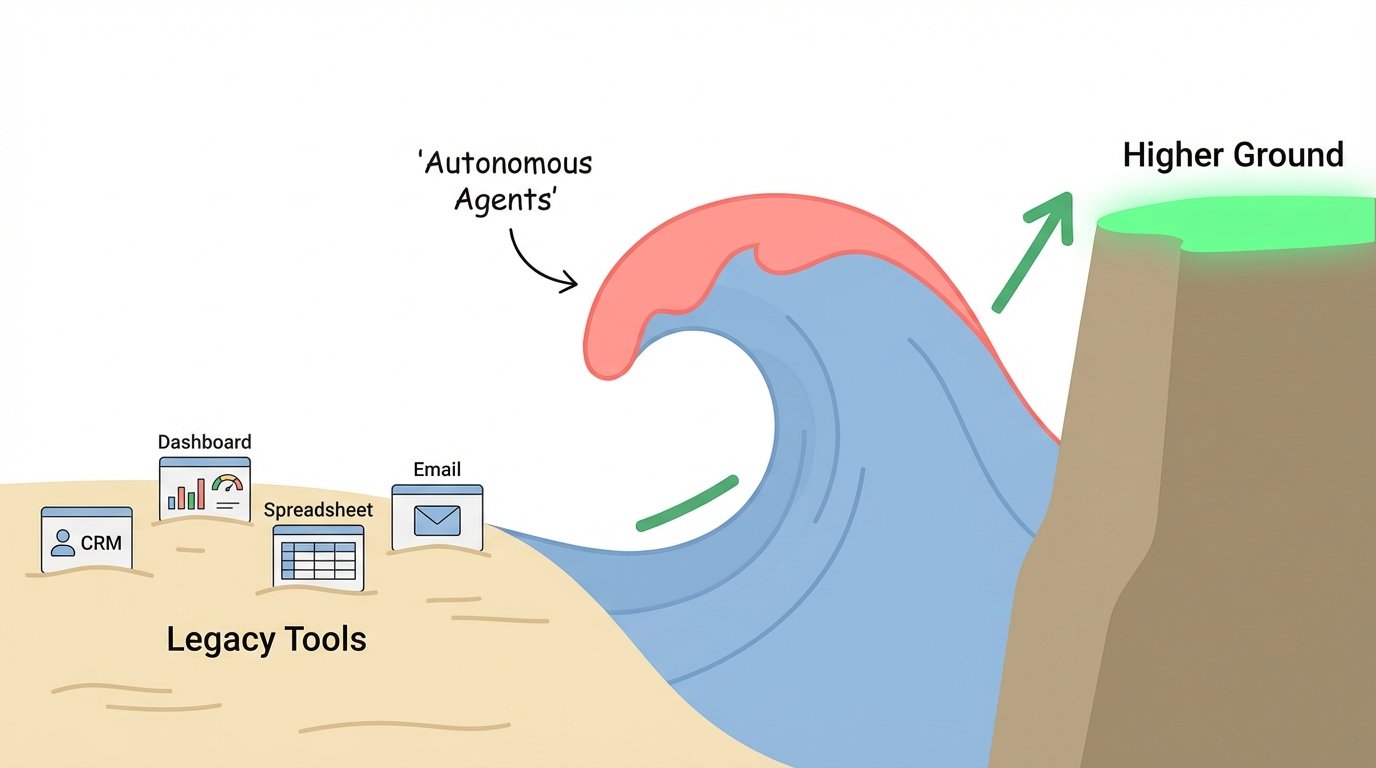
Don't get caught on the beach when the tsunami hits.
There's an analogy I keep coming back to when I try to explain what's happening in AI right now.
A tsunami is harmless when it's out at sea. It's only dangerous when it hits the beach. And right now, we can see it coming. That's the window — the anticipatory period before it arrives — where the businesses that move to higher ground will be the ones that survive and ultimately dominate what comes after.
The tsunami in this case isn't AI in general. It's specifically autonomous agents — AI that doesn't just answer questions but takes action, executes tasks, operates systems, and makes decisions on your behalf. That's the wave. And the businesses still standing on the beach are the ones piling features into their SaaS subscriptions, bolting AI onto the side of the way they've always worked, and waiting to see how it plays out.
Moving to higher ground means something different. It means restructuring how your business operates around what AI can now do. It means building an AI operating system.
The Third Industrial Shift
If you zoom out far enough, there have been only three moments in history that fundamentally changed how businesses operate.
The first was the industrial revolution — machinery and assembly lines that changed how we make things at scale.
The second was the internet — which changed how we reach people, opening global markets to anyone with a connection.
The third is happening now. And this one doesn't change what you make or who you reach. It changes how you run everything.
There's a parallel worth understanding here. Back in 2003–2004, companies couldn't afford to build websites on expensive enterprise servers. Then the LAMP stack arrived — Linux, Apache, MySQL, PHP — and it democratised web infrastructure overnight. What followed was the explosion of websites, e-commerce, and ultimately the entire internet economy. Google went public in 2004 and rode that wave brilliantly.
We're at the same inflection point with autonomous agents. The infrastructure is arriving. The agent stack is being built. And the businesses that build on it now — before it's obvious, before everyone else has caught on — will have the same compounding advantage that early internet businesses had over those who waited until 2010 to get online.
Bolt-On AI Doesn't Work
Here's what most business owners miss: bolting AI onto the way you already work is not the same as restructuring around what AI can do.
Bolt-on means: same workflows, same tools, same processes — but with a ChatGPT window open on the side. It has value. It's not transformation.
The businesses pulling ahead right now are doing something fundamentally different. They're building an AI operating system — an intelligence layer that wraps around the entire business, connects to real data, knows every client and every deal in context, and operates continuously without requiring human input on every action.
The analogy: it's the difference between hiring a new employee every morning and briefing them from scratch, versus having a co-founder who never forgets, never sleeps, and knows your business as well as you do.
What Is an AI Operating System?
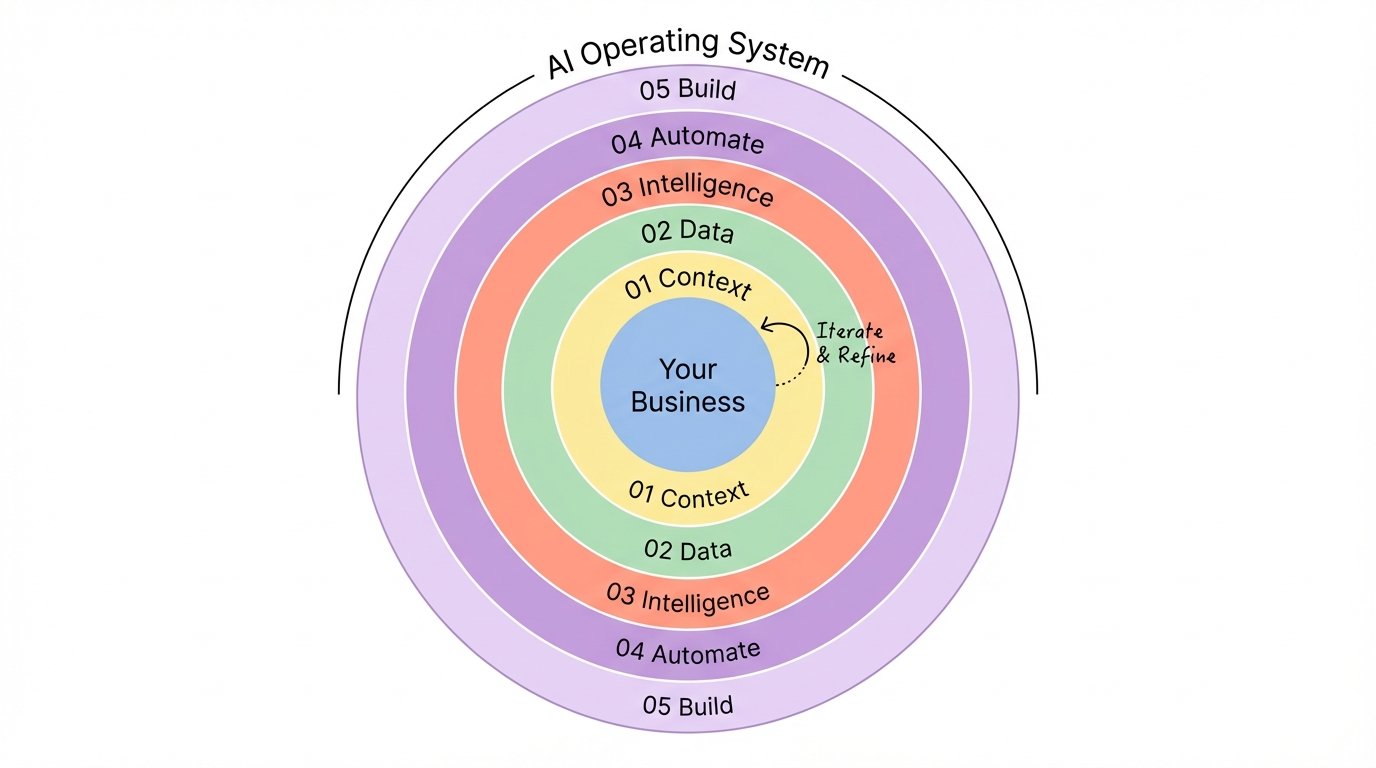
AI operating system — five concentric layers wrapping around your business
An AI operating system is not a SaaS tool, a dashboard, or a chatbot on your website.
It's an intelligent layer built specifically around your business — connecting your existing tools, learning your workflows and communication style, automating your recurring tasks, and delivering real-time intelligence directly to your phone.
Think of it like the operating system on your computer. You don't interact with it directly. You don't think about it. But without it, nothing else runs. An AI operating system is that layer for your business — running continuously in the background, handling what it can handle, and surfacing what needs your attention.
Definition: An AI operating system (AI OS) is an AI layer that wraps around your entire business — knowing your strategy, team, data, history, and clients — and takes action on your behalf every day, without requiring input on every task.
Think of your AI OS like a new team member. You give it credentials and access to the systems it needs. You review what it does, just like you would with any employee. The difference: it never takes leave, never has a bad morning, and gets smarter the longer it works with you.
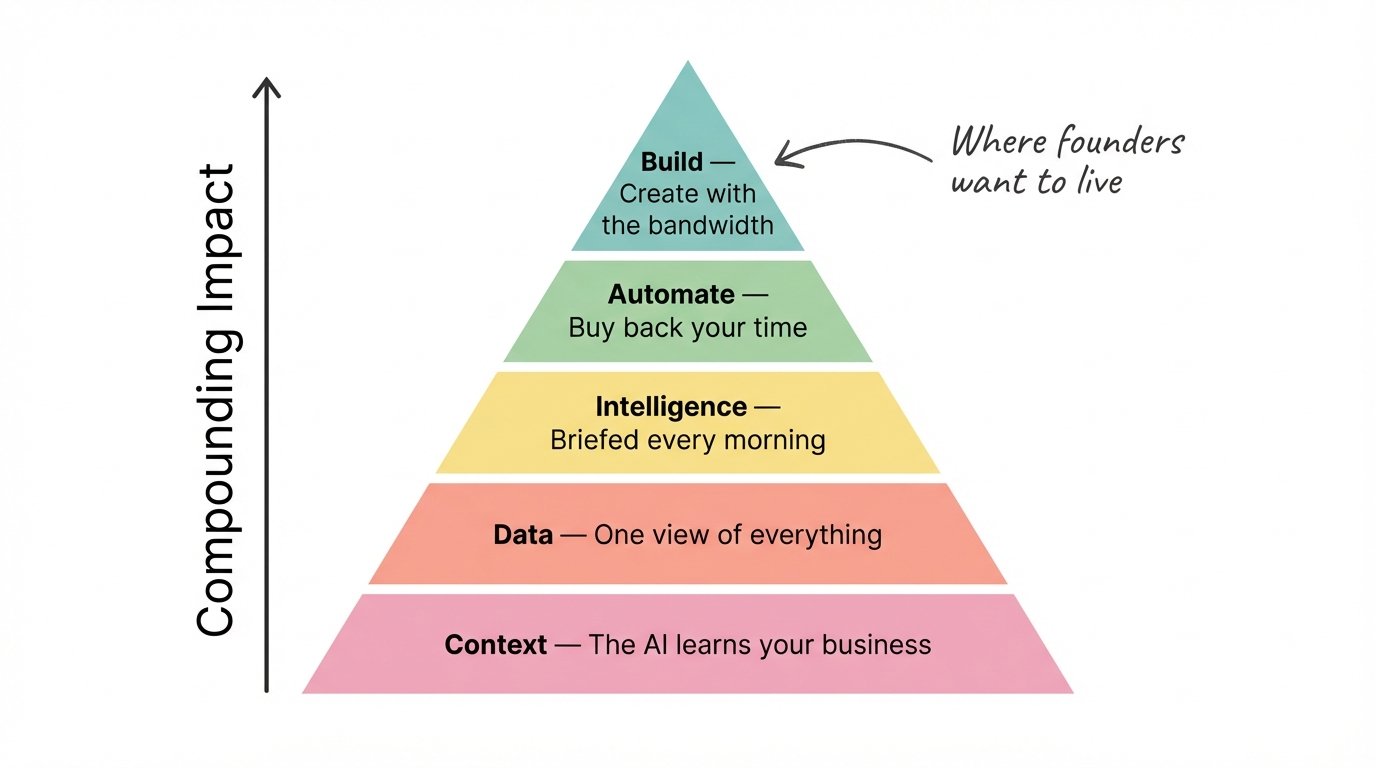
AI operating system pyramid — five layers from Context up to Build
The power of an AI operating system isn't any individual capability. It's the stacking. Each layer builds on the one below it. When all five are running together, the compound effect is unlike anything else available to a business operator right now.
Layer 1 — Context: The AI Learns Your Business Before any agent can act intelligently, it needs to understand your business the way a co-founder would — your team structure, strategy, revenue model, client history, processes, and voice. Every interaction starts fully informed. No briefing from scratch. No re-explaining your situation. It just knows.
Layer 2 — Data: One View of Everything How many platforms do you log into each morning just to understand what's happening? CRM, analytics, revenue, pipeline, team activity. The data layer consolidates all of it. You check the health of your business the way you check the weather — one glance, everything you need, no hunting.
Layer 3 — Intelligence: Briefed Before You Start Every morning, before your day begins, a full intelligence brief arrives on your phone. What happened across the business in the last 24 hours. Revenue movements. Meeting summaries from calls you didn't attend. Pipeline anomalies. Risks and opportunities. A complete picture — without sitting through a single meeting.
Layer 4 — Automate: Buy Back Your Time, Permanently This is where the leverage lives. Every recurring task — follow-ups, reports, proposals, data entry, client check-ins — gets assessed for automation. Once an agent handles a task, it handles it permanently. The gains compound: every week, more tasks crossed off, more bandwidth bought back. This isn't efficiency. It's structural.
Layer 5 — Build: Do Something With the Bandwidth When layers one through four are running, something happens most founders haven't experienced in years: real mental space. Not squeezed-out hours — actual bandwidth to think, create, and pursue new initiatives. Your AI operating system as a fully briefed co-pilot, ready to help you plan, research, and execute faster than a full team could.
How It Works Day-to-Day: The Approval Gate
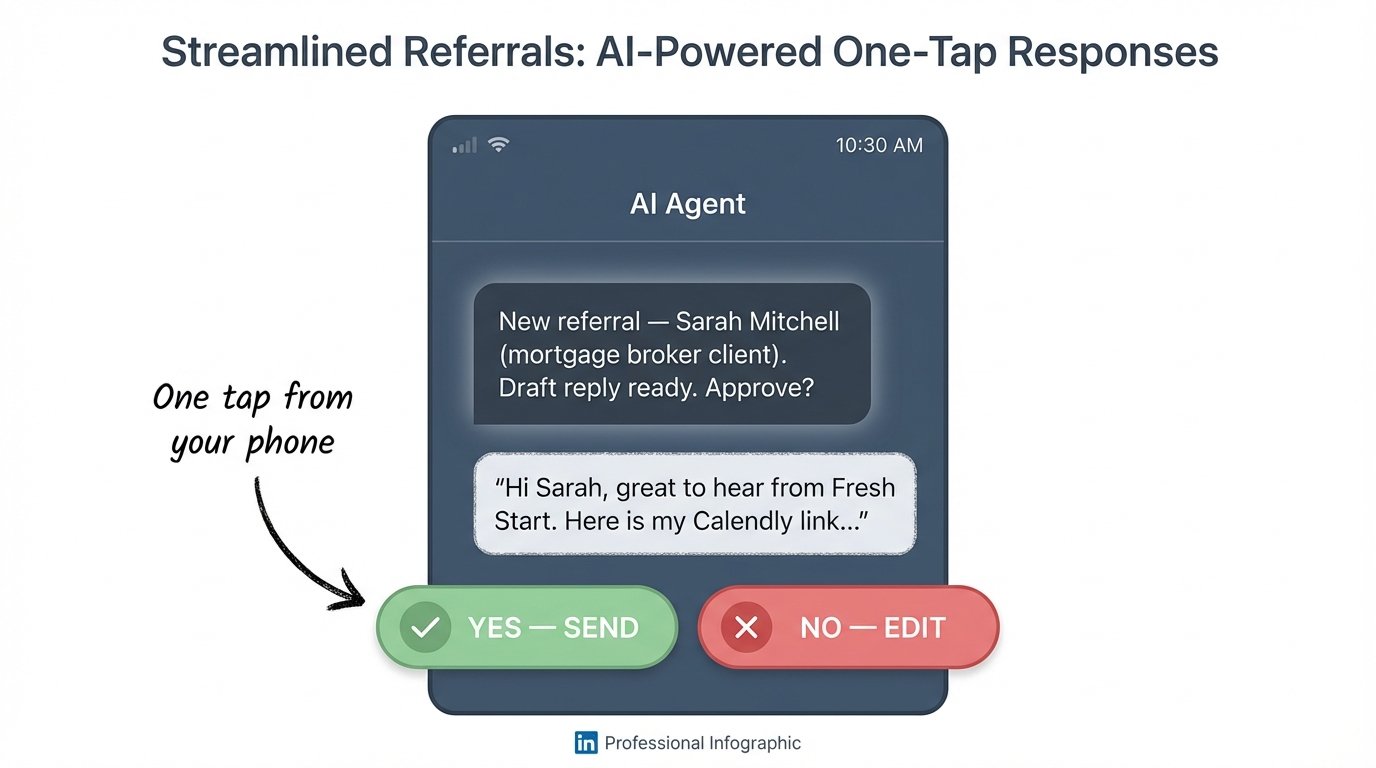
AI operating system approval gate — trigger, draft, Telegram notification, approve or edit
The thing that makes this practical — rather than theoretical — is the approval gate model. Nothing goes out without your sign-off.
Here's how every AI OS action works:
Trigger — A new lead enquires. A call ends. An invoice goes overdue. A quote goes cold.
AI drafts the action — An email reply, a proposal, a follow-up message, an alert.
Telegram notification — You get a message on your phone: "New referral — Sarah Mitchell. Draft reply ready. Approve?" with the full draft shown.
You tap Yes or No — Yes: it sends instantly from your own email address. No: it revises, or you edit and send.
That's it. You're the decision-maker. The AI is the executor. No automation fires blind. No messages go out without a human reviewing them.
What It Looks Like in Your Industry
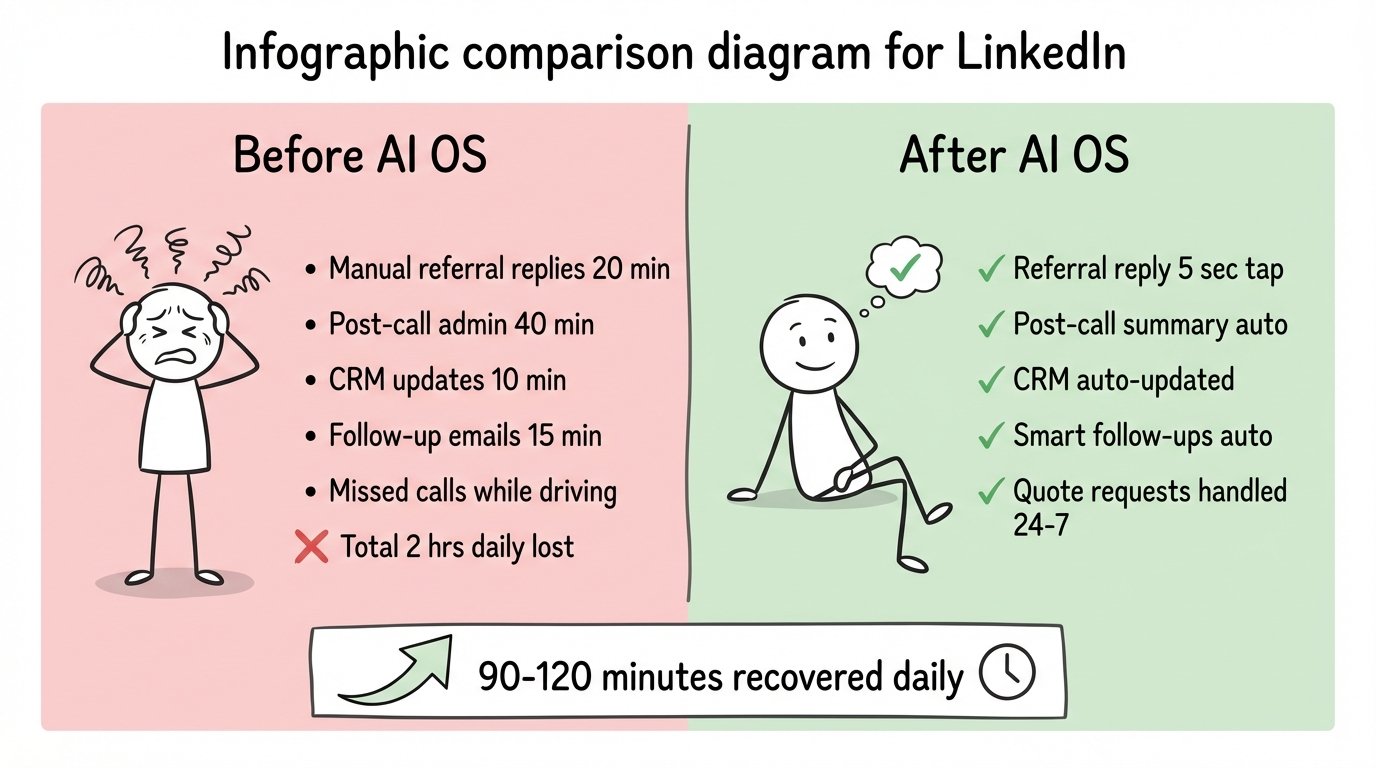
Before AI OS vs After AI OS — time recovered daily across mortgage broking, property, and trades
The five layers are universal. What they automate is specific to your business. Here's how an AI operating system translates across three industries we work in directly.
Mortgage Broking
For a mortgage broker, the product is specialist knowledge and relationship quality. The problem is the admin overhead that silently eats into the time available for both. A typical boutique brokerage loses 90–120 minutes of recoverable time every working day across three repeating patterns.
What an AI operating system handles:
Referral intake — Referral partner sends an intro email. The AI drafts a personalised reply in your voice, attaches your calendar link, sends it to Telegram: "New referral from Fresh Start — Jess Thompson. Approve reply?" Tap yes. Done. Currently 15–20 minutes per referral → 5-second tap.
Post-call summaries — After a discovery call, the agent reads the transcript, extracts borrowing capacity, recommended structure, required documents and next steps, then drafts both the client follow-up and the referral partner update — from your email — ready for approval within minutes. Currently 20–40 minutes of post-call admin per client.
Smart sequence management — Monitors your pipeline and automatically pauses active follow-up sequences the moment a client replies. Eliminates the double-contact problem.
Pre-meeting briefs — Before every appointment: who the client is, last contact, what they've submitted, deal stage, suggested talking points. Delivered before you dial in.
Pipeline intelligence — Weekly summary of deals stalling, follow-ups overdue, referral source performance. No manual reporting.
Connects into: Pipedrive, GoHighLevel, Fireflies, Otter AI, MeetGeek, Gmail, Calendly, Loan Market portals.
Property Management
The admin load in property management is structural. Every property in a rent roll generates a continuous stream of maintenance requests, inspection scheduling, lease renewals, owner updates, and tenant communications — most of which are repetitive, time-sensitive, and currently handled manually.
The primary friction: inbound call and request handling where agencies are under-resourced on reception during busy periods, and the coordination overhead of manually relaying information between tenants, landlords, and tradespeople.
What an AI operating system handles:
Inbound triage — New maintenance requests and rental enquiries assessed, categorised, and responded to automatically. Urgent maintenance flagged immediately; routine requests queued with an ETA sent to the tenant. The AI sends a Telegram prompt: "Urgent maintenance — 14 Birch St. Burst pipe reported. Escalate to emergency plumber. Approve?"
Inspection coordination — Routine inspection reminders sent to tenants, entry notices generated, post-inspection reports drafted and sent to landlords — the entire cycle handled.
Landlord intelligence briefs — Monthly automated update to owners: rent received, maintenance completed, upcoming lease renewals, issues flagged.
Lease renewal pipeline — Monitors upcoming expiry dates, initiates renewal conversations at the right time, flags situations needing a human decision.
Maintenance coordination — Tradesperson booked; tenant notified with access instructions; job tracked; landlord updated on completion. The entire chain handled.
Connects into: PropertyMe, Console Cloud, PropertyTree, Inspection Manager, MRI Software, GoHighLevel, SMS, email.
Trades and Field Service
For a trade business — air conditioning, electrical, plumbing, pest control, solar — the single biggest growth constraint isn't the quality of the work. It's everything around the work: calls missed while the owner is driving, quotes that go cold without follow-up, jobs that never get rebooked, reviews that never get requested.
Every missed call is a missed quote. Every owner who is also the de-facto receptionist is a business that caps out at their personal capacity.
What an AI operating system handles:
Inbound quote handling — Responds to enquiries immediately, asks the qualifying questions, generates an indicative price for standard jobs, routes for approval before confirming. The AI sends: "New quote request — Wahoo AC install, 3-bed low set Bracken Ridge. Standard job, indicative $1,450. Confirm and book?" No more pulling over on the side of the road.
Quote follow-up — Follows up on outstanding quotes. If declined, captures the reason — price, timing, went with a competitor — and logs it for downstream remarketing.
Post-job review requests — After job completion, a review request goes via SMS. Google review generation becomes systematic.
Lost job reactivation — Periodic outbound contact to customers quoted but didn't proceed. Recaptures business that was previously just gone.
Financial intelligence — Overdue invoices flagged. Weekly revenue and pipeline summaries. Xero monitored without logging in.
Connects into: ServiceM8, Fergus, Simpro, Jobber, Xero, GoHighLevel, Google Business Profile, SMS gateways.
The Integration Question
"We already have systems. Will this work with them?"
Almost always yes. An AI operating system connects into the tools you already run — not replacing them, but adding the intelligent orchestration layer those tools can't do on their own.
Security and Control
Every business in a regulated space — brokers, property managers, accountants — asks: "How do I know it won't send something it shouldn't?"
The answer is the approval gate model described above. Every agent action that communicates externally routes through a yes/no approval on your phone. Nothing goes out without your sign-off.
Beyond that: every client's AI operating system runs in an isolated environment. Your data is never pooled with other clients. Nothing is used to train external AI models. Every action is logged with a full audit trail. Any agent can be paused instantly. Where required, infrastructure is deployed on Australian servers for data sovereignty.
For financial services, property, and trades handling sensitive client data, these controls are built into the architecture from day one.
The Window
The businesses that implemented email marketing in 2003 had an advantage over those that started in 2010. The businesses that built SEO-optimised websites in 2008 ran ahead of those that got started in 2015. First-mover advantage in foundational technology compounds.
The businesses getting their AI operating system built now are not just getting efficiency gains. They're building an operational moat — a compounding advantage that will be very difficult to close in two or three years.
The tsunami analogy holds here. You can see it coming. There's time to move. But the window to move to higher ground before it hits the beach is not open indefinitely.
How We Build It
Every AI OS engagement follows the same structure:
Weeks 1–2: Discovery — We map your workflows, tools, and highest-friction points. We design the agent stack most likely to generate immediate ROI.
Week 3: Build — Agents built, integrations tested, prompts tuned to your voice and business context.
Week 4: Deploy — Go live, team onboarded, approval gates configured. We're on call for the first 30 days.
Ongoing: Retain and Expand — Monthly retainer covers monitoring, maintenance, and one new agent per month. Your AI operating system grows as your business grows.
Start with a Conversation
Every engagement starts with a free discovery call where we map your current workflows, identify your highest-ROI agent automations, and give you a clear picture of what's possible.


