
Why Australian Solar Leads Go Cold - What A Slow Callback Really Costs You
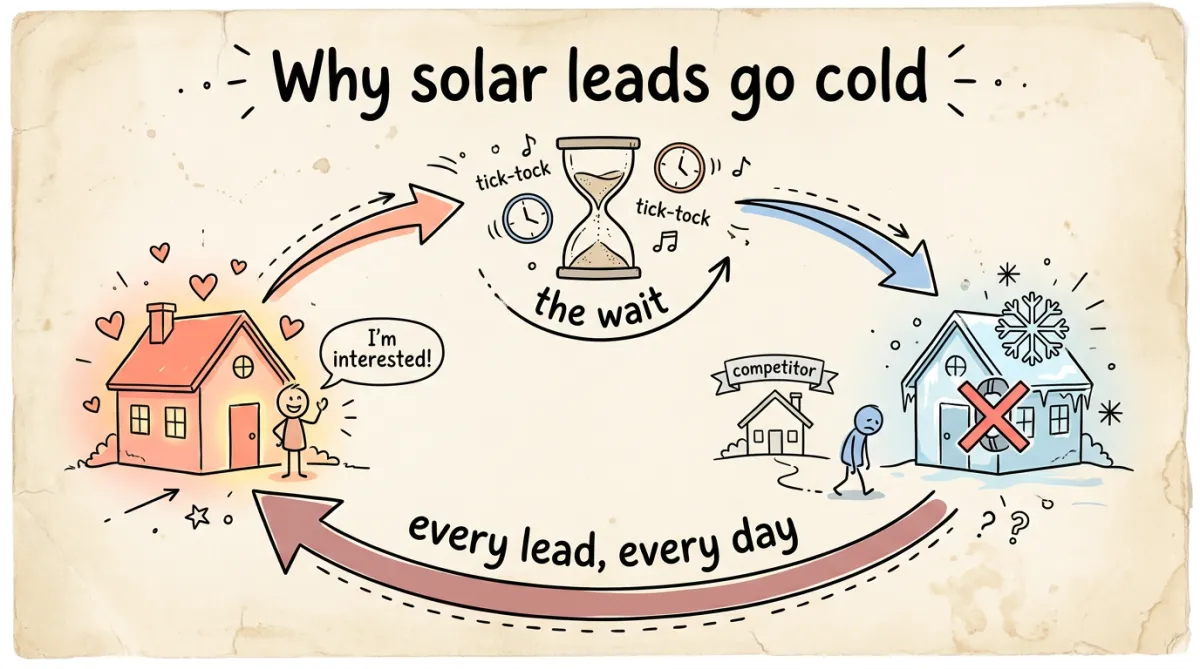
A warm solar lead cooling into a lost lead as time passes between enquiry and callback.
Most solar businesses think they have a lead problem. They actually have a follow-up problem. A lead called back within five minutes converts far better than one called an hour later - yet most installers take hours. Leads go cold in the wait between the enquiry and the callback, not because you needed more of them.
The money isn't wasted on the ad. It's wasted after the click
Picture the typical solar funnel. You spend real money putting an offer in front of homeowners. Someone sees it, gets interested, and fills in the form. At that exact moment they are the warmest they will ever be - phone in hand, thinking about their power bill, ready to talk.
Then what happens? The lead lands in a CRM - GoHighLevel, HubSpot, Zoho, Pipedrive, it doesn't matter which. A salesperson is on another call, or on a roof, or at lunch, or it's after hours, or it's the weekend. By the time someone rings back, the homeowner has moved on, filled in three other forms, or simply cooled off. That lead didn't die because your marketing failed. It died waiting.
That gap is where solar marketing budgets quietly leak. You can have the best ads in the market and still lose, because the game isn't won at the click. It's won in the minutes after it.
The evidence: minutes matter more than you think
This isn't a hunch. It's one of the most studied numbers in sales.
The MIT Lead Response Management Study, which analysed tens of thousands of leads and around 100,000 call attempts, found that contacting a lead within five minutes makes you about 100 times more likely to actually reach them than waiting just 30 minutes - and 21 times more likely to qualify them. The odds of reaching a lead at all drop more than tenfold in the first hour.
Harvard Business Review audited 2,241 companies and 1.25 million leads and found the same shape: firms that responded within an hour were roughly seven times more likely to qualify the lead than those who waited even one hour longer, and sixty times more likely than those who waited a day.
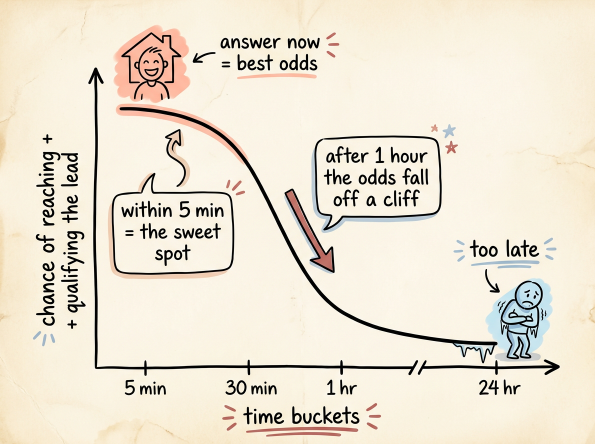
And the prize for winning that race is concrete: widely-cited industry figures put it at around 78% of customers buying from the first business that responds, and even on the more conservative estimates the first responder wins roughly half of all deals. First contact, not best pitch, wins most of the time.
Now hold that against reality. The average business takes over 40 hours to respond to a new lead. So the bar to beat your competitors isn't perfection. It's simply being the one who answers first.
Why your sales team can't win this race (and it's not their fault)
Here's the uncomfortable part. Speed to lead is not a coaching problem. It's a maths problem, and a human team cannot solve it.
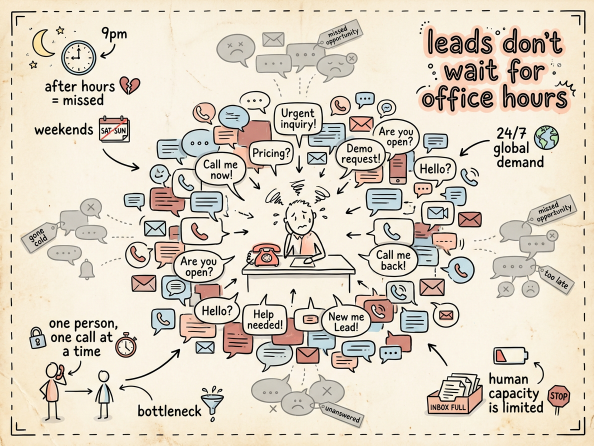
A person can only be on one call at a time. They sleep, they take breaks, they finish at five, they don't work Sundays. Leads don't respect any of that - a homeowner scrolling at 9pm is as warm as one at 11am. And most reps give up far too early: research puts the average at barely more than one call attempt before a lead is abandoned, when the leads that convert usually take several attempts across the first couple of days.
So even a great, motivated team is structurally guaranteed to let leads go cold. Not because they're lazy, but because you're asking a human to be instantly available to everyone, at once, around the clock. No one can do that.
The cost you can't see: a graveyard of cold leads
The damage compounds. Every lead that goes cold doesn't vanish - it piles up. Multiply a slow callback by months of ad spend and you get a database of hundreds, often thousands, of quotes that were paid for and never converted. Dead pipeline. Money already spent, sitting there doing nothing.
Most solar businesses are sitting on far more of this than they realise. It's the single largest hidden asset - and the clearest sign the problem was never how many leads you generate. It was follow-up speed and consistency.
What actually fixes it: an always-on first responder
The fix isn't "try harder" or "hire more reps". It's to make sure every single lead gets a fast, consistent, professional first response - every time, at any hour - without burning out your team.
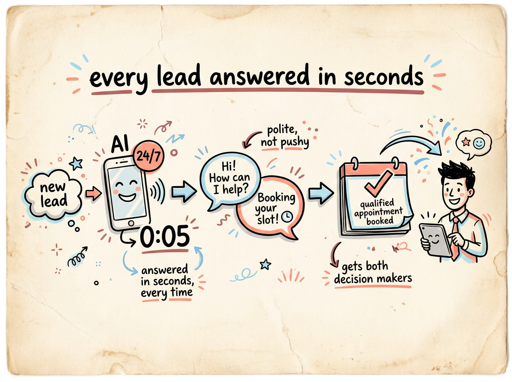
That's what an AI voice agent does when it's built properly. The moment a lead comes in, it calls. Not in three hours - in seconds. It has a real conversation, qualifies the homeowner, handles the basic questions, and books a genuine appointment straight into the calendar. And the strongest systems don't stop at one fast call - they follow up across voice, SMS and email under a single, consistent persona, so every lead is worked properly rather than dialled once and dropped. Your salespeople stop chasing cold leads and start turning up to booked, qualified assessments.
The key phrase is "built properly", because a badly built one does more harm than good. Here's the difference that matters.
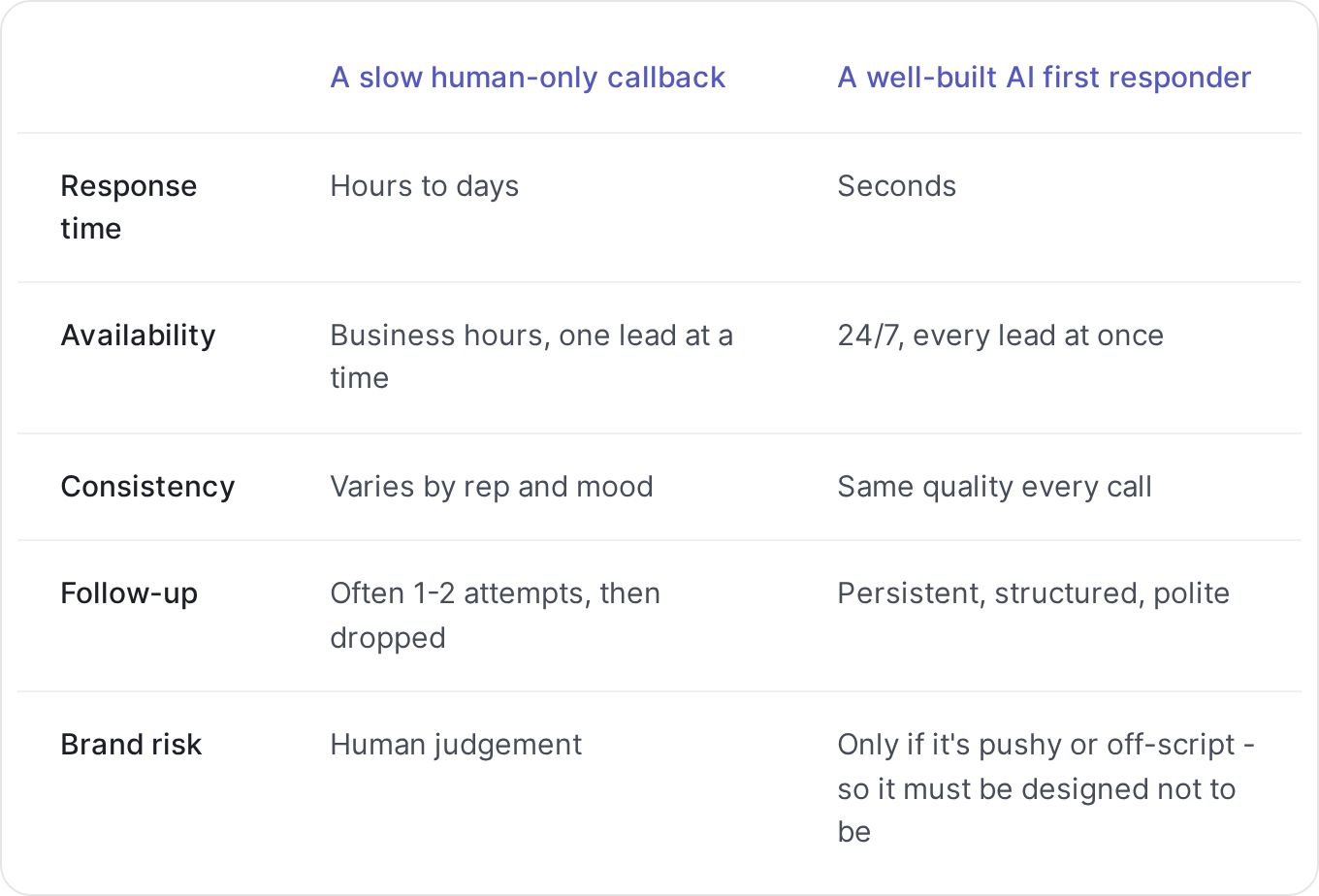
Notice the last row. The goal is not a robot that hammers people and earns one-star reviews. Done right, the AI is calm, non-pushy, and knows when to back off and hand a real human the warm, qualified conversation. That's the whole point: speed without damaging the brand you've spent years building.
What to check before you trust any AI with your leads
Speed alone isn't enough. If you go looking for this, make sure whatever you use does these four things, or it'll create new problems while solving the old one:
Qualifies properly, so your reps get real appointments, not a calendar full of tyre-kickers.
Gets both decision makers on the assessment, because in solar a quote where only one partner turns up usually stalls - "I'll have to run it past my wife" is where the deal quietly dies. It's a common, quiet killer of solar close rates.
Stays brand-safe, with a non-pushy style and a clean handoff to a human.
Has no surprise costs buried in per-minute phone charges you can't predict.
Get those right and speed to lead stops being your biggest leak and becomes your biggest edge.
Frequently asked questions
How fast should you actually call a solar lead? As close to immediately as possible. The research is consistent: within five minutes is the target, and every minute after that measurably lowers your odds of reaching and qualifying the lead. Within the hour is the bare minimum to stay competitive.
Isn't a fast human callback good enough? Only if you can guarantee it every time, at every hour, for every lead - which no human team can. The leads that arrive after hours, on weekends, or while your reps are busy are exactly the ones that go cold, and they're a big share of your spend.
Won't an AI caller annoy people and hurt our reviews? It can, if it's built to push hard for a booking. A well-designed one does the opposite: it's polite, it takes no for an answer, and it hands upset or complex calls to a human. Brand safety is a design choice, and it's the first thing to check.
The bottom line
You don't have a lead problem. You have a follow-up problem. Every hour between a homeowner raising their hand and someone actually talking to them is money leaving the building, quietly, on repeat. Fixing it isn't about spending more on ads or squeezing your team harder. It's about making sure no lead ever waits - and that's the one thing an always-on first responder can guarantee and a human team never can.
See it work before you decide anything
You don't have to take our word for any of this. We've built the whole thing - the instant engagement, the multi-channel follow-up, the sales psychology, the brand-safe design - into a live demo you can watch for yourself.
No pitch, no obligation. Just see how it actually handles a lead, and decide from there.


