Will Your AI Agent Misquote A Rebate? What Brand-Safe Solar Voice AI Actually Looks Like
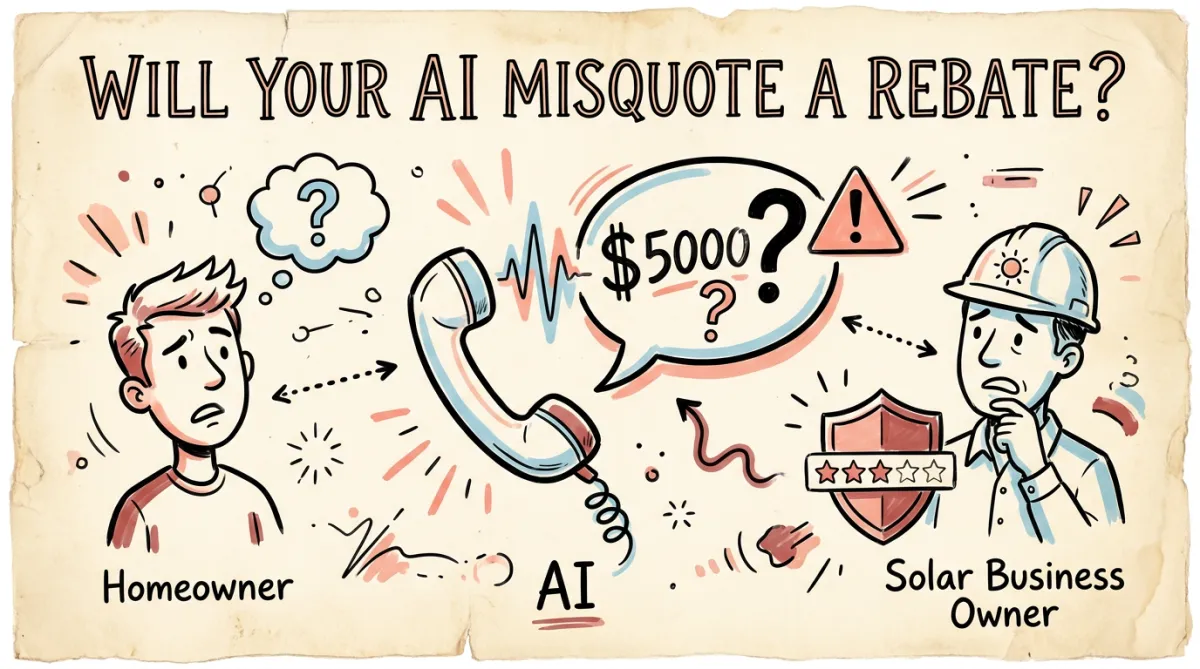
An AI voice agent quoting an uncertain rebate figure while a homeowner and a solar owner look on warily.
AI voice agents are safe for your solar business only when they are built to be. The horror stories - an agent quoting the wrong rebate, hounding a homeowner into a bad review, breaching the calling rules - are design failures, not proof the technology is dangerous. Here are the four risks, and what to demand.
The real worry isn't AI. It's an AI with your name on it saying the wrong thing
Most solar owners we talk to are not afraid AI won't work. They have seen it book appointments. What keeps them up is the opposite - that it will work, at scale, and somewhere in those hundreds of calls it says something wrong, pushy, or non-compliant, and it goes out under their brand.
A four-panel sketch of the brand-safety risks of AI calling - misquoting rebates, pushy calls, compliance breaches, and made-up answers.
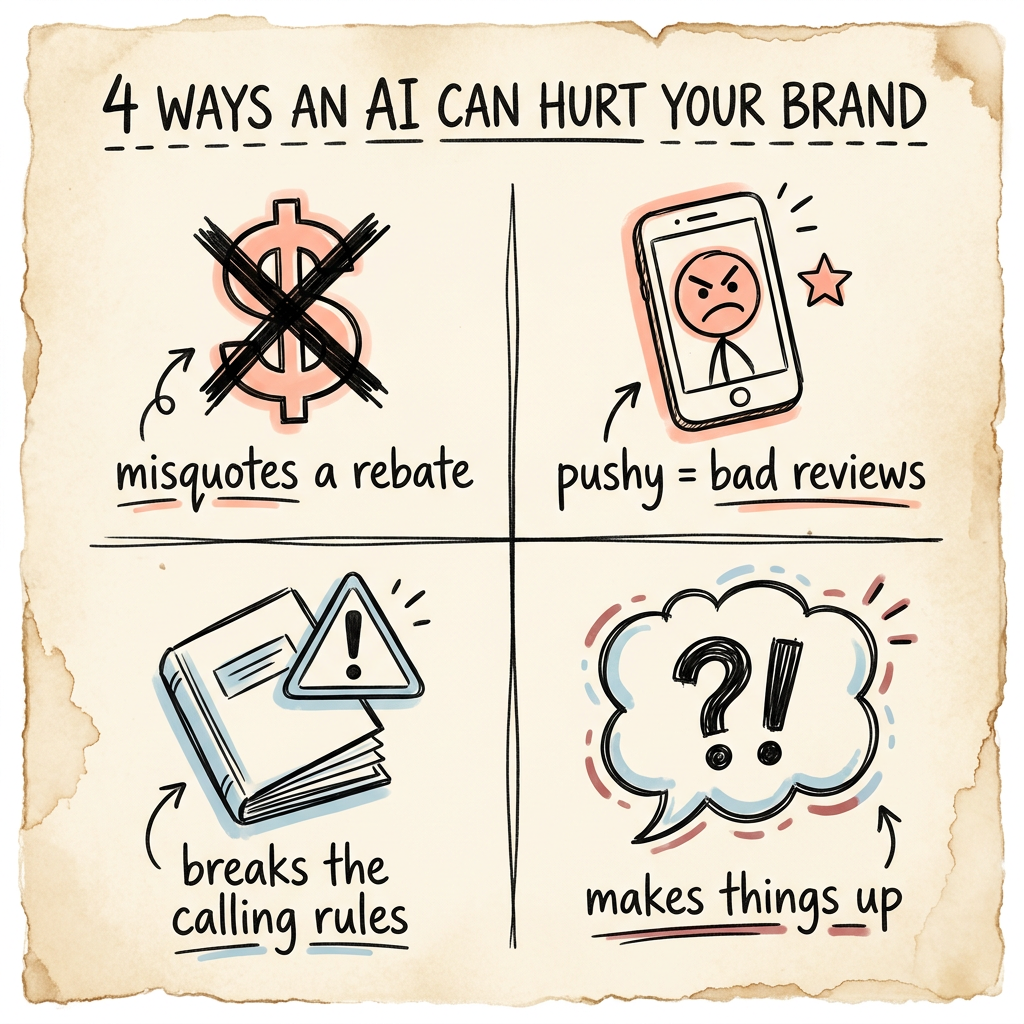
That is a fair worry, and it is the right one. In solar, trust is the whole sale. Homeowners are already wary after years of aggressive door-knockers, and your reviews are hard-won. One bad automated interaction, repeated across a calling list, can undo a lot of that quietly. So the question is not "is AI safe" in the abstract. It is "did whoever built this one make it safe." Four risks decide the answer.
Risk 1: It misquotes a rebate or a price
This is the big one for solar, because so much of the pitch hinges on numbers - the federal small-scale certificate incentive, state battery rebates, the final out-of-pocket figure. Those numbers change, they vary by system size and location, and they are exactly the kind of thing a poorly built AI will confidently improvise. An agent that states a rebate the customer does not actually qualify for has just misled them, damaged trust before a human is even involved, and potentially created an Australian Consumer Law problem for you.
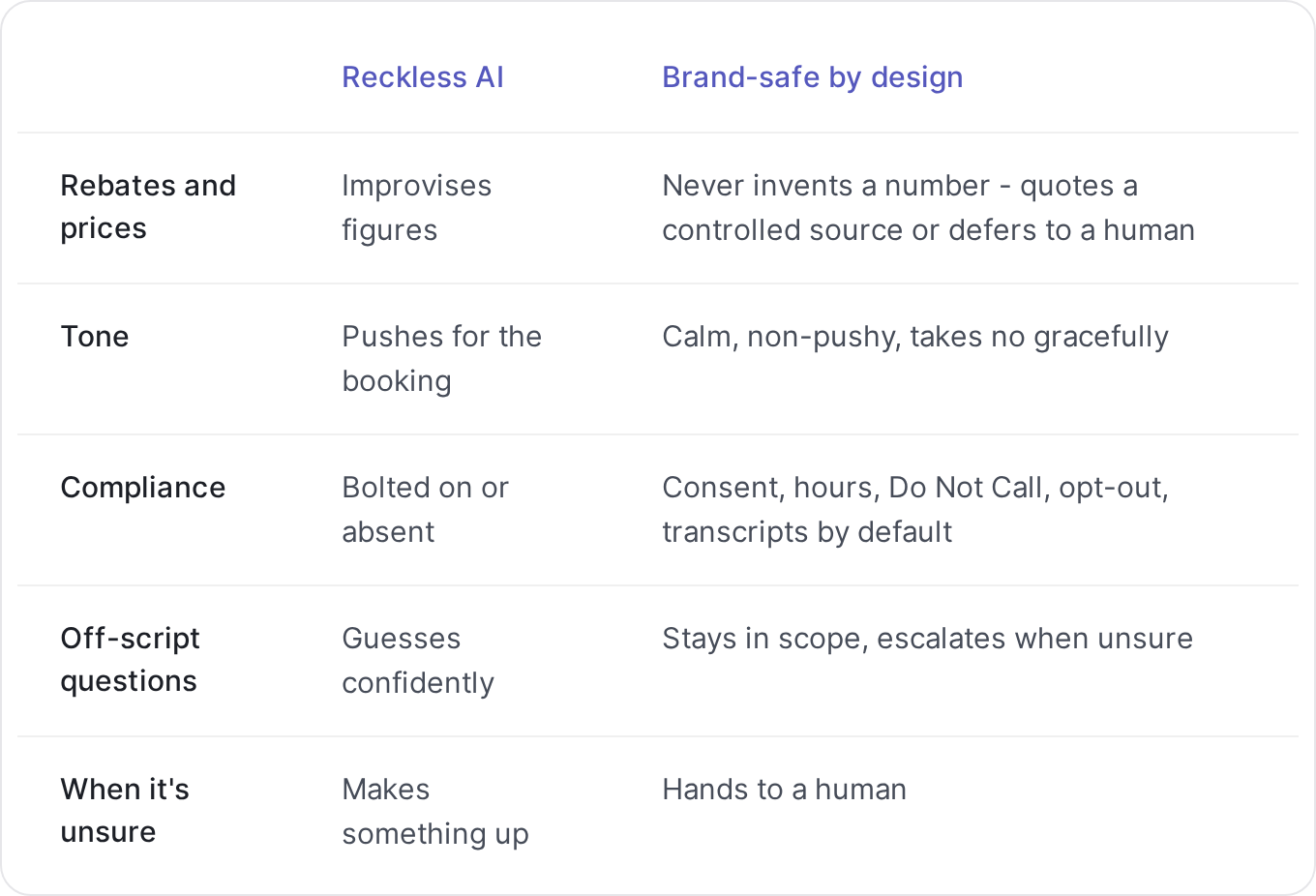
What to demand: the agent must never invent or estimate a figure. It either quotes from a controlled, current source or it says a human will confirm the exact numbers. Being vague and accurate beats being specific and wrong, every time.
Risk 2: It is pushy, and earns you a one-star review
An AI built to chase the booking at all costs will call too often, talk over people, and refuse to take no for an answer. On a human that is a bad rep you can coach. On an automated system it is the same mistake, thousands of times, and each one is a homeowner who can leave a public review. Given solar's reputation baggage, that is the fastest way to turn a lead-generation tool into a brand liability.
What to demand: a calm, non-pushy style, hard limits on how often it calls, a graceful exit when someone says no, and an immediate handover to a human when a caller is upset. The best systems go further - engineered restraint, where each message carries a single persuasion lever rather than a stacked hard sell, and the follow-up deliberately eases off near the end instead of manufacturing "last chance" pressure. Brand safety here is a design choice, not luck.
Risk 3: It breaches the Australian calling rules
AI does not exempt you from the rules that apply to any outbound calling - consent, the Do Not Call register, permitted calling hours, and the Australian Consumer Law around misleading conduct. Plenty of AI deployments launch with none of these controls because the vendor optimised for booked appointments and treated compliance as someone else's problem. It looks fine until a complaint or an audit turns your marketing tool into a liability.
What to demand: consent handling, a calling-hours limit, Do Not Call screening, honoured opt-outs, and a full transcript of every call so you can prove what was said.
Risk 4: It goes off-script and makes things up
A general-purpose AI pointed at your customers will, sooner or later, answer a question it should not - inventing a warranty detail, a timeline, or a claim about your service. In a regulated, high-trust purchase, a confident wrong answer is worse than "let me get a human to confirm that."
What to demand: a tightly scoped knowledge base, clear limits on what it will and won't discuss, and a clean escalation path the moment it is out of its depth.
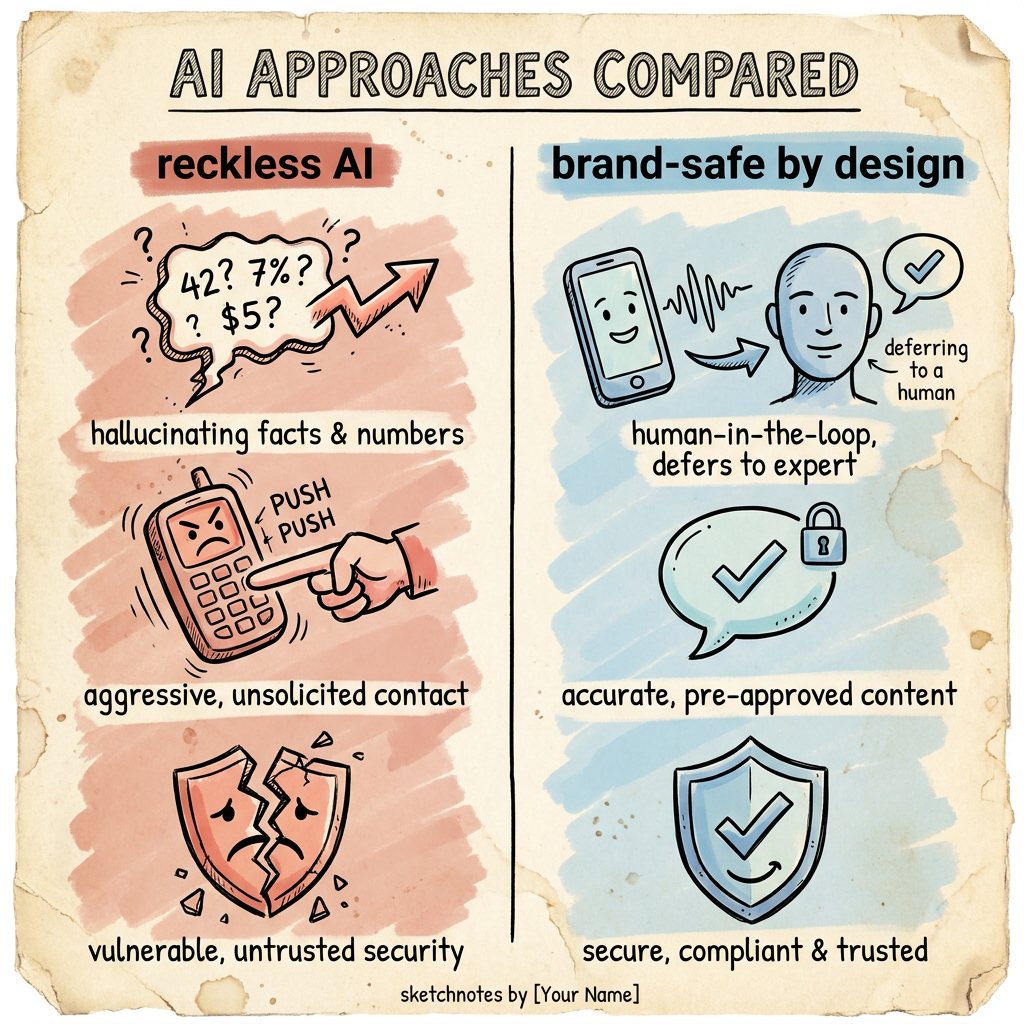
Reckless AI vs brand-safe-by-design AI
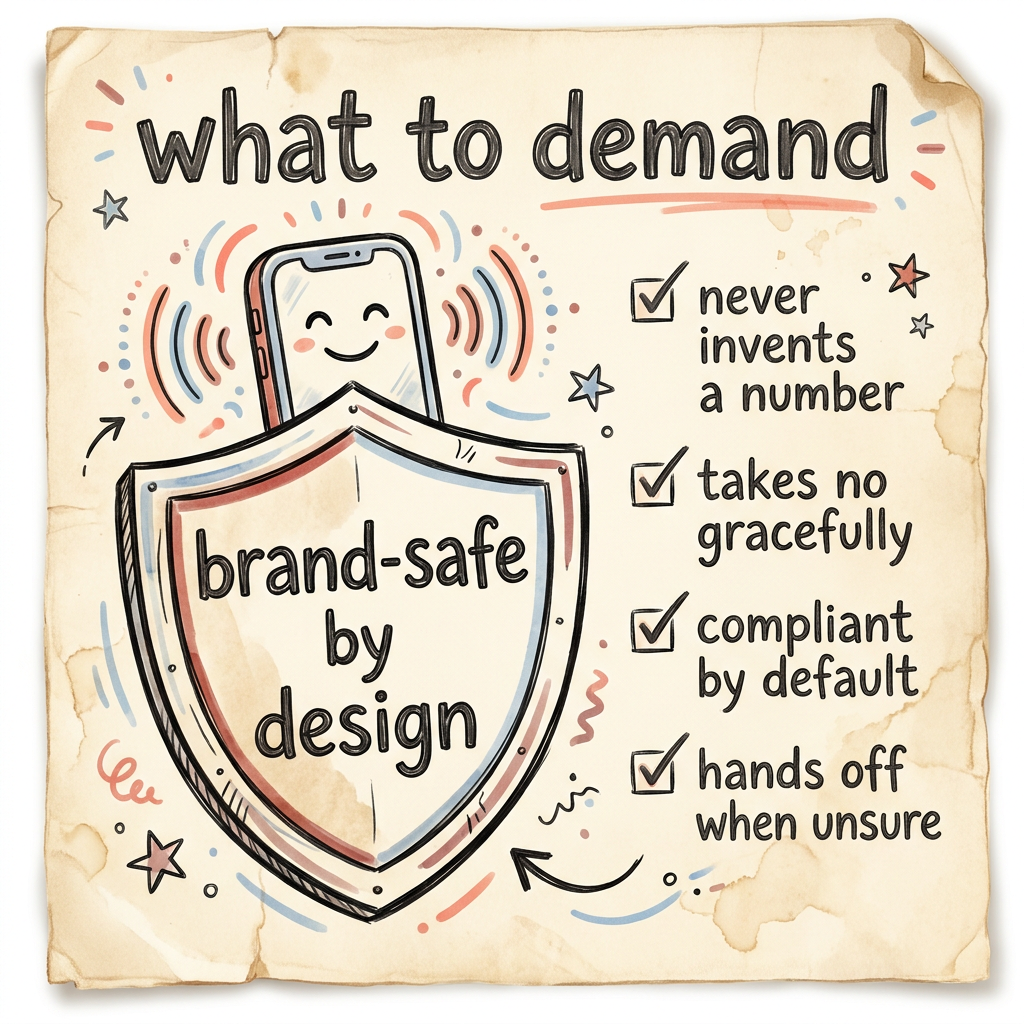
What to demand before you switch one on
If you are assessing any AI voice solution, hold it against these five questions:
Can it be made to never quote a figure it isn't certain of?
How does it behave when a homeowner is annoyed or says no?
Show me the compliance controls - consent, hours, Do Not Call, opt-out, transcripts.
What is it allowed to talk about, and what happens when it's asked something outside that?
Can I read and hear exactly what it said on any call?
If a vendor cannot answer those plainly, that silence is your answer.
Frequently asked questions
Is it safe to let an AI talk to my solar customers? Yes, if it is built to be. The failures - wrong rebate figures, pushy calls, compliance breaches, made-up answers - are design choices, not inevitabilities. A well-built agent is calm, stays in scope, never invents numbers, and hands off to a human when unsure.
Will an AI caller hurt my Google reviews? It can, if it pushes too hard. A brand-safe one is designed to be polite, cap how often it calls, take no for an answer, and escalate upset callers - which protects your reviews rather than risking them.
Is AI cold calling legal in Australia? It can be, with the right controls - consent, permitted calling hours, Do Not Call screening, honoured opt-outs, and honest, non-misleading conduct. AI does not remove those obligations.
The bottom line
The question was never "is AI safe for solar." It is "did whoever built this one make it safe." A brand-safe agent is a series of deliberate decisions - never improvise a number, stay calm, stay compliant, stay in scope, hand off when unsure. Get those right and AI protects the brand you have built. Get them wrong and it puts your name to a mistake, at scale.
See it work before you decide anything
You don't have to take our word for any of this. We've built the whole thing - the instant engagement, the multi-channel follow-up, the sales psychology, the brand-safe design - into a live demo you can watch for yourself.
No pitch, no obligation. Just see how it actually handles a lead, and decide from there.


